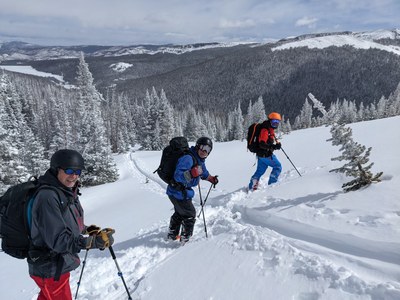
Introduction to Backcountry Alpine Skiing - Northern Colorado - 2026

Backcountry Skiing/Splitboarding Course

Introduction to Backcountry Alpine Skiing

A brief workshop to introduce backcountry beginners and novices to the joy of skiing outside the resorts with Alpine Touring (AT) equipment and techniques. No previous backcountry ski experience or avalanche safety training is required but you should be comfortable skiing blue runs at the resort.

*** TO REGISTER FOR THIS COURSE, PLEASE FIRST COMPLETE THE REGISTRATION QUESTIONNAIRE AND SUBMIT IT TO THE COURSE DIRECTOR.  YOU CAN ACCESS THE QUESTIONNAIRE BY CLICKING THE BLUE 'APPLY' BUTTON ON THE RIGHT HAND SIDE OF THIS PAGE.  THANK YOU. ***

OVERVIEW

Getting started with backcountry skiing can be confusing with numerous options for skiing styles, equipment and avalanche safety training. This workshop is designed for those who are brand new to the activity and want to test it out in a friendly instructional environment before making larger investments in gear and education. It is also suitable for those who may have dabbled but would to like to learn more about equipment options, transition techniques, trip planning, operating as a team, and the differences between various avalanche education options.

This Workshop is NOT an avalanche education course. We will cover some safety basics and provide guidance on education options you can pursue after this Workshop if you would like to continue to your backcountry journey (we think you will!). We believe many students will get more from their initial avalanche rescue courses with some prior introduction to backcountry skiing and safety gear.

If you would like to better understand the difference between this type of skiing and Backcountry Nordic, take a look at this table.

WORKSHOP FORMAT

This Workshop will consist of one evening classroom session on January 20, 2026.  Those who sign up for the classroom session may optionally sign up for a field day (either January 24th or January 25th) where we will practice climbing, descending and transitioning on some mellow non-avalanche terrain, with slope angles less than 25 degrees.

FITNESS LEVEL

Backcountry skiing requires fitness and the ability to climb steadily at elevation with a winter backpack and 10+ pounds of weight on your feet (ie, skis, boots and bindings) and the need to break track at times. Although we will be traveling at a casual pace with longer than normal stops for instruction, participants should have a fitness level commensurate with the activity. For example, if you are able to summer hike above 10,000 feet with an elevation gain of about 1000 feet per hour, you should be to join one of the Workshop Field Days. If you have questions or concerns, please feel free to contact the Course Director Manuel Fillon at Manufillon@gmail.com. 

CLASSROOM SESSION TOPICS

The classroom session will cover the following topics:
  • Backcountry skiing overview.
    • How it differs from resort skiing. Is it fun? (spoiler alert: yes!)
    • What is AT and how does it compare to other types of backcountry skiing?
  • Equipment
    • Options for skis, boots, bindings, skins, poles. What’s best for your experience level and the type of skiing you’d like to do.
    • Where you can find reasonably-priced rental equipment in our area for the Field Days and other trips.
  • Safety considerations
    • Avalanche safety basics
    • Follow-on education options: Avalanche Terrain Avoidance, AIARE 1, Companion Rescue. Considerations for specific backcountry activities and terrain.
    • Other hazards
  • Clothing and pack essentials.
  • Preparation for a backcountry ski day.
    • Making a plan
    • Weather forecast resources
    • Avalanche forecasts
    • Group dynamics

OPTIONAL FIELD DAYS

Participants must attend the Classroom Session to join one of the optional Field Days.

Participants do not need previous backcountry experience but should be very comfortable skiing blue runs at the resort.  This is not a ski lesson:)

We will ski in the Cameron Pass area with exact location to be determined based on snow conditions and daily weather forecast.

See Required Gear section for what to bring on the field day; this will also be discussed during the Classroom Session.

After an initial orientation, we will go in small groups with two instructor-leaders and no more than three students. We will discuss and practice the following:
  • Climbing techniques and considerations.
  • Being efficient with your transitions between uphill and descent modes.
  • Terrain consideration for descents.
  • Recovering from a fall.
  • Considerations for skiing as a group.

We will be skiing non-avalanche terrain, but we will discuss basic avalanche safety considerations and demonstrate the use of search and rescue equipment (beacon, probe and shovel). We will also bring extra beacons for students to use. We will also discuss non-avalanche hazards and other safety matters.
Course Requirements

This course has no scheduled activities.

Roster
Required Equipment

EQUIPMENT NEEDED

No equipment is needed for the classroom session.

For the field day, we will be focusing on skiing with Alpine Touring equipment (aka Randonee). You will need to bring skis, boots, climbing skins, ski poles, helmet and eye protection on the field day. We can help you find rental equipment from local shops. If you have solid telemark experience and gear, you may use that. However, our field day terrain is not well-suited for split-boards.

You will also need to bring all the necessary winter layers and winter pack essentials, which will be discussed in-depth during the classroom session.