Wilderness Medicine
The Colorado Mountain Club offers Wilderness First Aid and Wilderness First Responder classes through Backcountry Pulse. All Backcountry Pulse programs are taught to the current internationally accepted wilderness medicine guidelines and are continually updated to reflect the latest evidence-based practices. All courses are globally recognized.
Earn college credit for CMC Wilderness Medicine classes through Red Rocks Community College! Earn 1 credit (WFA) or 4 credits (WFR) through the RRCC Outdoor Education Program. CMC Wilderness Medicine classes taught by Backcountry Pulse can be approved for credit. Not all WFA or WFR courses may be approved. Please see these attached documents to receive credit for WFA or WFR.
- CMC Wilderness Medicine courses are taught through Backcountry Pulse.
- All courses are taught to current internationally accepted wilderness medicine guidelines.
- WFA certification is valid for two years with no grace period.
- WFR certification is valid for three years with no grace period.
Wilderness First Aid 16 Hours
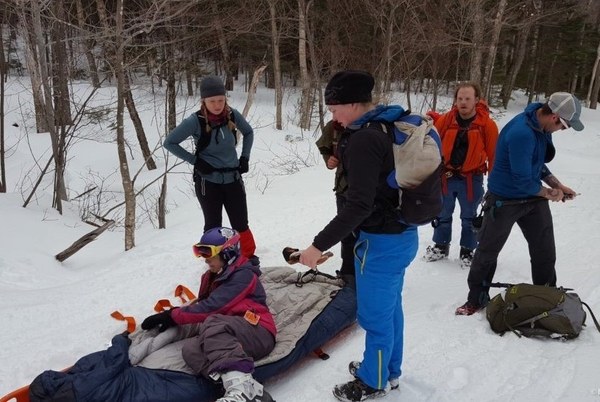
The WFA course teaches students the skills to anticipate risks and hazards, identify medical, traumatic, and environmental problems, recognize life-threatening issues, initiate basic care, and deliver a cohesive report. The curriculum forces students to think creatively, adapt to ever-changing situations, and learn valuable leadership, decision-making, and communication skills.
Format: Our 16-hour WFA is fully in person, usually running Saturday–Sunday from 8am–5pm.
Objectives
- Rescuer, patient and bystander mental health
- Inclusive and compassionate patient care
- Prevention of potential problems
- Performing a basic physical exam, identifying abnormalities and life-threatening problems, obtaining vital signs, patient history, and writing and verbalizing a report for a walk-out evacuation or hand-off
- Treatment and stabilization of emergencies, improvising splints, bleeding and wound control, management of heat and cold illnesses, hydration problems, drownings, lightning injuries, spinal cord protection, basic patient lifts and transfers
- Cardiopulmonary resuscitation and special considerations for the wilderness, epinephrine administration, and first aid kit planning for specific activities and needs
- While CPR techniques are discussed in the WFA course, students will not earn a CPR certification.
Minors aged 16 and up are eligible for certification with instructor approval and a signed parental waiver.
Minors aged 14–15 may audit the course if accompanied by a parent or guardian throughout the course.
Certification: WFA certifications are valid for two years with no grace period. Certification can be kept current by taking a 16-hour WFA class within the two-year period.
Are you passionate about Wilderness Medicine? Do you want to share your skills with others? Participate in our instructor training program and give back to the Club.
Wilderness First Responder Hybrid Course
Level up your outdoor education and medical training with Wilderness First Responder! WFR is intended for outdoor professionals who volunteer or work multi-day trips in a backcountry setting. The curriculum forces students to think creatively, adapt to ever-changing situations, and learn valuable leadership, decision-making, and communication skills.
Format: Our hybrid WFR course combines self-paced online learning and hands-on in-person training. This format is more accessible for weekday workers.
- Pre-course online training: 30 hours
- In-person hands-on training: 6 in-person contact days (50 hours total). In-person class and field days take place over two consecutive weekends from Friday–Sunday, 9am–6pm.
Objectives
- Rescuer, patient, bystander mental health
- Inclusive and compassionate patient care
- Risk mitigation for the environment and activity
- Ongoing management for environmental threats
- Spinal stabilization and patient packaging
- Patient physical exam and patient history
- Recognition of life threats and stabilization of emergencies
- Signs and symptoms of medical, traumatic, environmental illnesses and injuries
- Initiation of appropriate treatments based on assessment
- Patient monitoring and vital sign patterns
- Clear and concise verbal report and written documentation
- Planning, appropriate evacuation methods and patient handoffs
Certification
- Wilderness First Responder
- Epinephrine Auto-injector training
- Adult/child CPR & AED
- All certifications listed above are valid for three years with no grace period. WFR can be kept current by taking a Wilderness First Responder or Wilderness First Responder Recertification (WFR-R) within the three years.
Volunteer as a WFR Patient
Volunteer as a patient during our Wilderness First Responder course. Volunteer shifts are approximately 3 hours on a Saturday at Betasso Preserve in Boulder. Refresh your skills, gain a new perspective, and earn a $50 credit toward your own WFR course!
Please complete the form if you are interested in this opportunity.
This course includes CPR in wilderness environments, automated external defibrillator, and how to help a choking victim. This course does not qualify for the AHA Basic Life Support (BLS) for Health Care Professionals.
Note: This course includes compressions and rescue breaths, as recommended by the current American Heart Association guidelines.
Format: This is a 2½-hour course for a small class size of 10 students.
Instructors are CPR/AED and Wilderness First Responder certified. Students will earn a two-year Adult CPR/AED certification from ECSI.
"Go from Bystander to Lifesaver" — Participants in the course will learn how to recognize life-threatening bleeding and act quickly and effectively to control it with three quick techniques. The ACS Stop the Bleed training course empowers participants to make a life-or-death difference when a bleeding emergency happens. Courses are offered on a rolling basis.
If you are interested in learning more skills related to incident management and survival in the wilderness, check out our series of classes focused on Risk & Incident Management. These include Wilderness Survival School and Backcountry Incident Management School (BIMS).
LEARN MORE